Services
Our services are tailored to client needs, combining regulatory expertise and the latest scientific knowledge to ensure excellence.
The following sections outline our capabilities.
For more information or if your requirement is not covered below, please contact us.
Consultancy: Underwater noise modelling and EIA

Environmental Impact Assessment Support
Underwater Noise is included in many Environmental Impact Assessments (EIAs). Many protected marine mammal species and commercially significant fish species are sensitive to underwater noise, and therefore careful management of noise generating activities is a regulatory requirement for most marine developments.
Useful for: Regulatory advice and support, expert representation
Acoustic Modelling
Underwater Noise Modelling is an essential component of many marine Environmental Impact Assessments (EIAs). Modelling is required to predict the level and spatial extent that noise generated by potentially significant sources covers in the habitats of protected species, and is crucial for assessing the risk that a project could have, as well as the need for and choice of mitigation or noise abatement.
Subacoustech carries out modelling of all commonly considered underwater noise sources, especially piling for offshore foundations and UXO clearance.
We primarily use the following modelling software:
INSPIRE
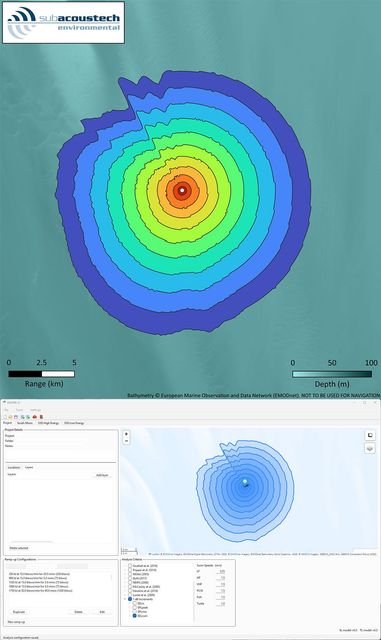
LIGHT
A low resolution version that has been adapted to run very quickly in a workshop setting. Useful for identifying potentially problematic scenarios at very early stages.
Useful for: Early stage project planning/ scoping.
FULL VERSION
A range-dependent, semi-empirical broadband noise propagation model developed by Subacoustech and refined over more than 10 years using hundreds of field datasets. Thanks to the nature and scale of the data used in its development and validation, INSPIRE has demonstrated accuracy in predicting noise from piling events—particularly in environments similar to the North Sea and UK continental shelf. Over 200,000 pile strikes in database covering range of energies, ranges, pile diameters and bathymetries.
Useful for: Modelling of impact piling.
SPEAR
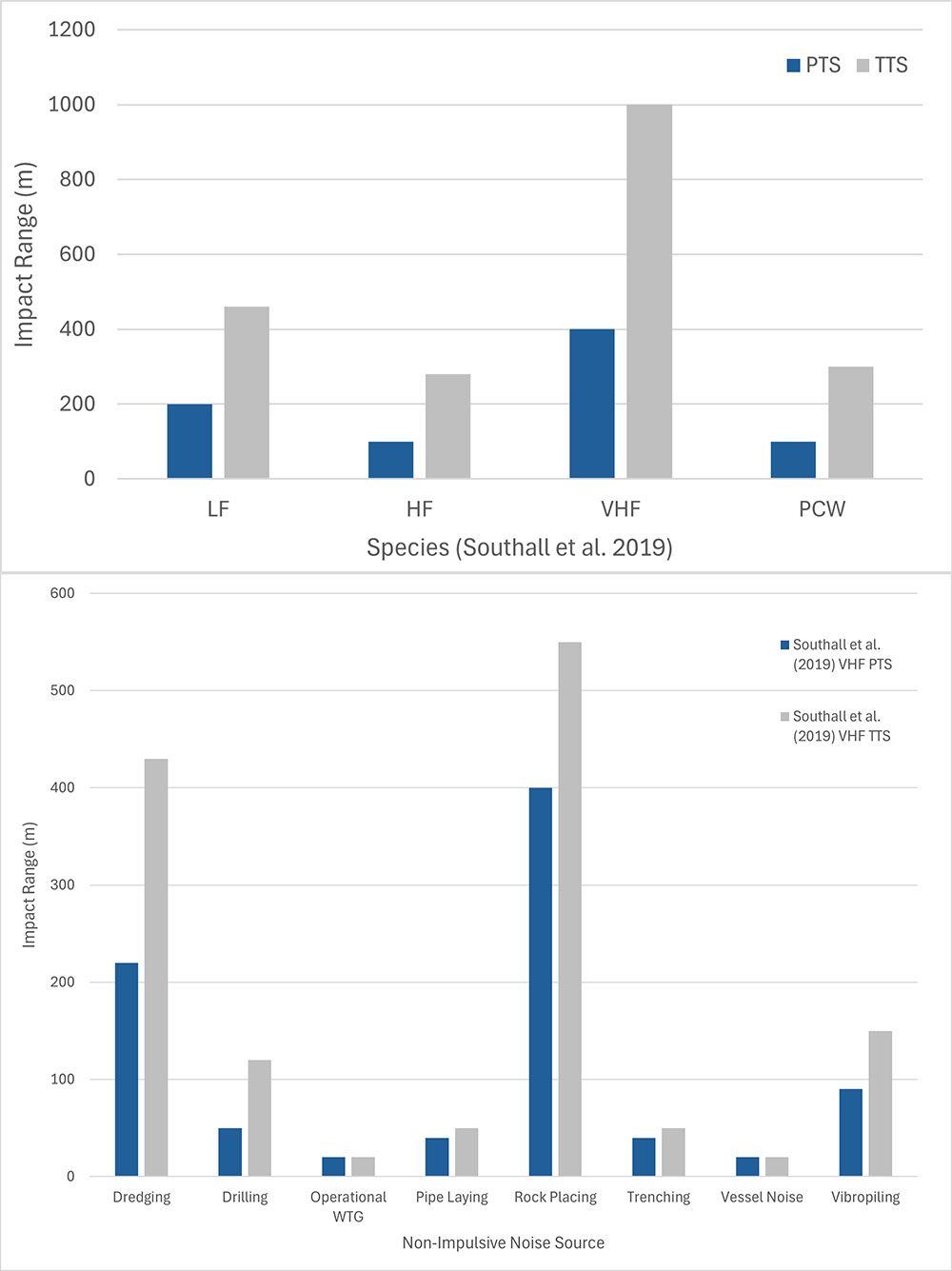
A simple geometric spreading model that uses measured source level data and ranks underwater noise sources according to the likely magnitude of effect.
Useful for: Modelling of low intensity sources (dredging, drilling, vessel noise etc.).
dBSea
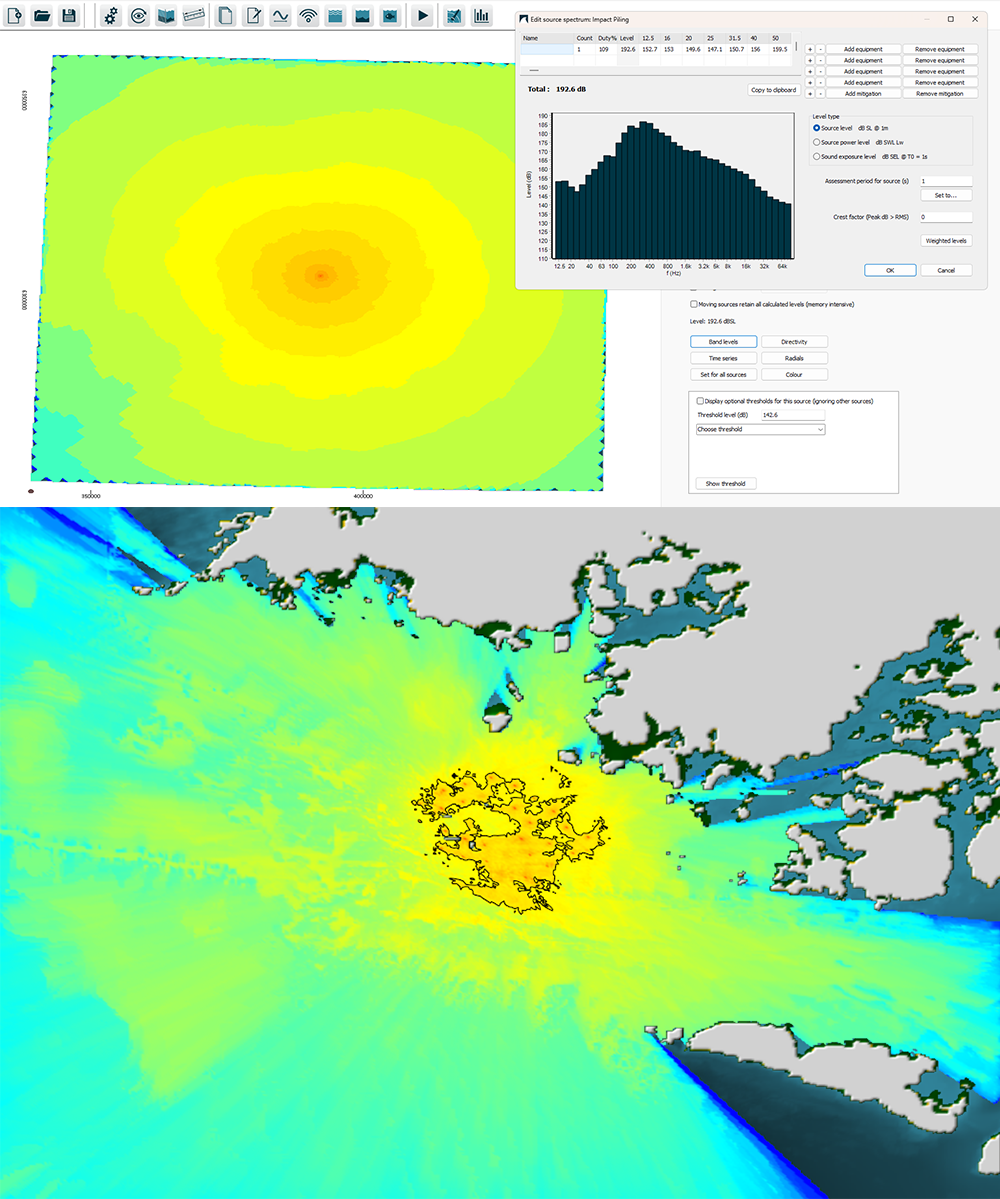
Developed by Marshall Day Acoustics, and Irwin Carr Consulting, dBsea is used as a tool to predict underwater noise. It has a variety of solvers available, such as parabolic equation (PE), ray tracing and normal modes, to be able to predict transmission loss in complex underwater environments.
Useful for: Modelling of high intensity noise sources, including those outside of the UK (impact piling, UXO clearance, seismic surveys).
Underwater Noise Measurement and Monitoring

Acoustic Monitoring
Acoustic monitoring involves recording and analysing underwater sound to track and assess ambient noise, identify sources, and track changes over time. It supports the detection of anthropogenic activities, marine mammal presence and compliance with environmental noise regulation.
In the early days of Subacoustech, there were very few monitoring systems commercially available that met our requirements so we designed and built our own. We are continously innovating and developing our range of monitoring solutions to improve the services available to clients.
We have established relationships with electronics specialists, precision engineers and hydrophone manufacturers to develop our own bespoke systems specifically targeted at the requirements of our clients.
We use fully calibrated, instrumentation-grade hydrophones and recording systems to suit a wide range of monitoring scenarios.
Fully Attended Monitoring
This approach ensures highly reliable data collection by allowing data quality to be verified in real time. Measurements are conducted across a wide area and at multiple depths to capture spatial variation. This can be complemented with fixed-position monitoring to assess changes over time, providing a comprehensive understanding of both spatial and temporal noise patterns.
Useful for: Inshore construction noise monitoring.
Autonomous Monitoring
LONG TERM (3 MONTHS OR MORE)
Our systems continuously process and store noise data while simultaneously recording raw audio on a set schedule. This offers low power consumption whilst making the best use of storage.
Useful for: Baseline noise monitoring, offshore construction noise monitoring, real-time exceedance alerting.
SHORT TERM (UP TO 10 DAYS)
Our monitors are configured to continuously record high-quality underwater sound at sampling rates of up to 500 kHz. Where needed, real-time monitoring can also be enabled via a wireless connection.
Useful for: Single event monitoring (e.g blasting).
Continuous Real-time Monitoring
Our real-time monitoring solution can provide real-time recording and analysis according to the requirements of the project. Results are uploaded to our reporting servers and made available to the client in a bespoke dashboard showing the relavent metrics and threshold.
Useful for: Compliance with fixed daily noise limits. E.g. 1 minute or single pulse (peak detection) sound exposure levels with progress towards daily or 24-hour cumulative sound exposure limits.

Acoustic Analysis
Acoustic analysis is the quantitative assessment of underwater sound using collected data, which undergoes signal processing, and analysis. It is used to characterise natural and anthropogenic sources, evaluate sound propagation, and assess potential impacts on marine fauna. Our work supports source level estimation, regulatory compliance, EIAs, and the development of effective noise mitigation strategies. We use a range of industry-standard and custom tools for acoustic data analysis, ensuring accurate, efficient, and flexible workflows tailored to each project’s requirements.
Signal Processing and Data Analysis
We have physicists and acousticians with expertise in programming and analysis tools such as Matlab and Python for advanced signal processing and automated processing.
Using our large database of real world recordings to develop and refine machine learning models we are able to rapidly process large datasets to identify and analyse features of interest and provide visualisations tailored to project-specific needs. Our data management processes have been designed to enable rapid re-analysis of historical datasets against the latest weightings and assesment criteria.
There is no "one-size-fits-all" approach to data analysis our approach is not limited by third party software or tools. For each project, our approach will be guided by the objectives of the project and the outputs that will most useful or relevant to the stakeholders.
Useful for: Whatever you need! However you want to cut, slice and present your results we can do it.
Software Development
In addition to bespoke analysis, we also develop our own software to support our data analysis process and measurement systems.
Useful for: Sound source verification, model/EIA validation
PAMGuard
The leading open-source software for real-time Passive Acoustic Monitoring. Used for detection, classification, and localisation of marine mammals, PAMGuard is a core part of our monitoring and mitigation services.
Useful for: Marine mammal detection and classification
Research
Through targetted research, we can:
Noise Mitigation - PAM and ADD Equipment Rental
Passive Acoustic Monitoring is used to detect, classify, and monitor underwater sound sources (particularly marine mammals and anthropogenic noise) without introducing additional noise into the environment. Acoustic Deterrent Devices (ADD) are often required to cause animals to leave an area immediately prior to the start of a noisy activity to minimise the risk of auditory injury. They both play a key role in regulatory compliance and real-time mitigation during offshore activities to detect the proximity between marine mammals and anthropogenic noise sources. Subacoustech design and build a range of PAM and noise mitigation systems, services and solutions, which we have developed alongside experienced operators to provide a comprehensive, user friendly and cost-effective system that rivals and can exceed class leaders, ensuring high-quality data collection in diverse marine conditions.

Towed PAM
Our towed PAM system is suppled as a four hydrophone array provided on a 250m reinforced cable suitable for towing. The hydrophones are broadband and omnidirectional. The system's topside is supplied in a rugged 4u case, designed to take up as little space as possible on any deployment vessel. Our equipment integrates with PAMGuard, the industry standard for PAM operations. In addition to supplying PAM hardware, Subacoustech also supply experienced operators including JNCC- and BOEM-approved MMOs, PAMOps and PSOs through our partners within the Asteroceras group.
Click here for the technical specification.
Vertical PAM
Our vertical PAM system is a light weight, hand carriable battery powered system designed for use in static applications and on small vessels.Powered by the same high frequency (up to 500 kS/s sample frequency) DAQ card as our towed PAM system, the vertical PAM system is supplied with a single broadband omnidirectional hydrophone on a 50m cable.
Acoustic deterrant devices and other systems
Subacoustech also provide other devices associated with noise mitigation. The Lofitech Acoustic Deterrent Devices (ADD or seal scarer) are battery powered and hand carriable, and is available for hire for active noise mitigation. Autonomous click detectors such as the Chelonia F-POD are also available for hire.